Frontify vs Bynder: brand portal or DAM?
Frontify starts from brand guidelines, Bynder from digital asset management. A factual comparison of features, templates, workflows, AI and integrations, and how to pick the right fit.

Jean-Baptiste DuquesneSEO, GEO & content operations · Published 25 October 2026 · Updated 13 November 2026
In short: Frontify starts from brand guidelines and calls itself "the intelligent brand system where your guidelines, assets, and brand knowledge live". Bynder starts from enterprise digital asset management and presents itself as "the most intuitive enterprise DAM platform". Both now cover parts of the other's ground. Pick Frontify if your main need is to publish and enforce brand rules; pick Bynder if your main need is to manage a large asset library with workflows. If your bottleneck is producing on-brand variations, look at the production layer too.
Method: information taken from the official websites of both vendors in November 2026. Comparison pages published by vendors about each other are not neutral. No price is quoted, as neither vendor publishes one on its homepage.
Frontify vs Bynder in one minute
| Criterion | Frontify | Bynder |
|---|---|---|
| Starting point | Brand guidelines and brand knowledge | Enterprise DAM |
| Brand guidelines | Core product: "One home for your brand guidelines" | Not a standalone product; brand compliance agents check assets against guidelines |
| DAM | Yes, with automatic tagging and natural-language search | Core product, with AI search |
| Templates and on-brand creation | Templates with brand rules built in | Studio, to scale content on brand |
| Workflows and approvals | Not highlighted on the homepage | Asset Workflow and Content Workflow |
| AI | Brand Assistant that answers questions, finds files and drafts content | AI agents for compliance, enrichment, transformation, governance and automation |
| Integrations | API and MCP, so AI tools can read brand knowledge | Pre-built integrations with the marketing stack |
| Customers named | Microsoft, Budweiser, Telefónica, OpenAI, Bayer, Uber, Lufthansa Group | Spotify, Lacoste, Molson Coors, Campari Group, Mazda, Riot Games; "4000+ brands" |
| Best for | Brands that want one living home for their rules and assets | Organizations with large asset volumes and approval processes |
Brand portal vs DAM: what is the difference?
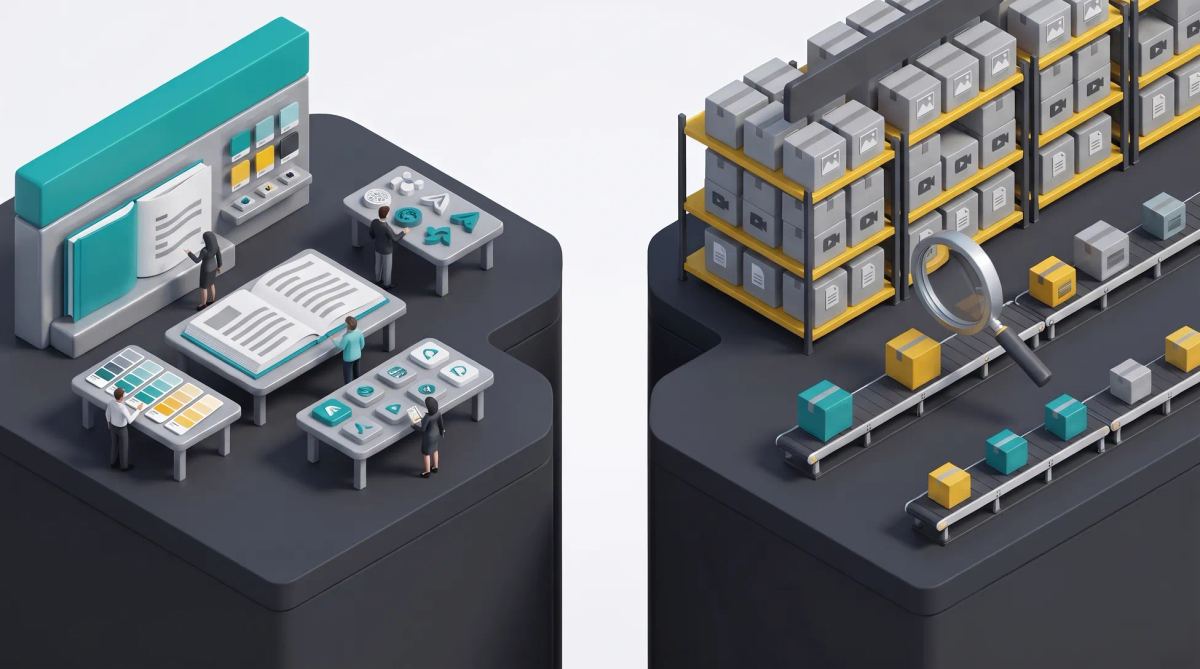
A brand portal is the shop window of the brand: it gives employees, agencies and partners the guidelines and the approved assets they need, with controlled access. A DAM is the warehouse: the system of record for every digital asset, with metadata, rights, versions and workflows. Many organizations need both. For the DAM side, read our guide to digital asset management.
Brand guidelines and brand portal
This is Frontify's home ground. Guidelines live next to the assets, so teams and AI agents can stay compliant. The Brand Assistant answers brand questions, locates files and drafts on-brand content, and Frontify makes brand knowledge available to AI tools through its API and an MCP server.
Bynder does not sell guidelines as a standalone product. Its approach is to check assets automatically against brand guidelines and regulations with brand compliance agents. For more on Frontify, read Frontify features: strengths and limits for content production.
Digital asset management
This is Bynder's core. It centralizes and manages assets for large organizations, adds an AI search experience and enrichment agents, and claims more than 4,000 brands. Frontify also offers a DAM, where each asset is automatically tagged and described and can be found with a keyword or a plain-language request. For an organization whose first problem is a very large, fragmented asset library, Bynder's depth is the natural starting point. Read our Bynder analysis.
Templates and on-brand content creation
Both offer template-based creation. Frontify builds brand rules into templates used by local, global and AI-assisted teams. Bynder's Studio is designed to scale content faster while staying on brand. Before choosing, test the formats you actually produce: banners, video, print, multiple languages. Template depth varies a lot between platforms. For the governance angle, read brand governance platform: role and key features.
Workflows, AI and integrations
Bynder puts workflows forward: Asset Workflow to speed up content approvals, Content Workflow to create, review and approve editorial content at scale. Frontify's homepage does not highlight approval workflows; check its product pages and run a trial if this is critical for you.
On AI, Frontify focuses on making brand knowledge usable by people and AI tools, including through MCP. Bynder offers several types of AI agents, from compliance checks to transformation and automation. Both connect to the wider marketing stack.
Which one should you choose?
- You want to centralize and share your brand rules, and keep them readable by AI tools: Frontify.
- You manage a very large asset library with approval processes: Bynder.
- Your bottleneck is producing multi-format, multilingual variations with local teams: add a creative automation platform, connected to your DAM or with its own.
For more options, read our Bynder alternatives and our Frontify alternatives.
Brandeploy: from brand rules to on-brand production
When the need is production, Brandeploy combines an asset library, templates locked to your brand guidelines, multi-brand management, roles and permissions by brand, project or content, translation and localization of creatives and approval workflows. Local teams and partners adapt creatives without source files, and Brandeploy connects to Bynder when your assets already live there. Learn more about brand management in Brandeploy or book a demo.
FAQ
Is Frontify a DAM?
Frontify includes a DAM, where assets are automatically tagged and described and can be searched in plain language, but its starting point is brand guidelines. It calls itself an intelligent brand system for guidelines, assets and brand knowledge.
Does Bynder have brand guidelines?
Bynder does not present guidelines as a standalone product. It offers brand compliance agents that automatically check assets against brand guidelines and regulations.
Which is easier to use, Frontify or Bynder?
It depends on the user. Frontify is designed around guidelines that any employee can browse; Bynder is designed around an asset library and workflows. Test both with the people who will use them daily.
Can you use Frontify and Bynder together?
Some organizations do, using Bynder as the asset system of record and Frontify for guidelines. Check the available integrations before choosing this setup, as it adds licenses and maintenance.
What are the alternatives to Frontify and Bynder?
Brandfolder, Canto, Papirfly, Marq, Air or Acquia DAM, depending on whether you need a DAM, local templates or lightweight asset management. If you need on-brand variations at scale, a creative automation platform such as Brandeploy completes the stack.

Written by
Jean-Baptiste Duquesne
SEO, GEO & content operations
Web pioneer since 1995, founder of the recipe site 750g.com (sold to Webedia), now industrialising SEO and GEO content production with AI.
Ready to scale your content production?
Book a demo