Frontify features: strengths and limits for content production
Frontify: A Leader in Brand Management and Guidelines Frontify has established itself as a premier platform for organizations seeking to centralize their brand identity. Its core strengths lie in providing comprehensive brand portals,…

Jean-Baptiste DuquesneSEO, GEO & content operations · Published 19 September 2025 · Updated 12 October 2026
Frontify: A Leader in Brand Management and Guidelines
Frontify has established itself as a premier platform for organizations seeking to centralize their brand identity. Its core strengths lie in providing comprehensive brand portals, robust digital asset management (DAM), and interactive brand guidelines. A close look at these features makes it clear that the tool is designed to ensure that every stakeholder, from internal employees to external agencies, remains aligned with the brand's visual and strategic DNA.
In the context of modern marketing, having such a repository is essential. It prevents brand dilution by offering a single source of truth. However, as teams look to scale their efforts, they often explore a creative automation platform for enterprises to move beyond simple asset storage. While Frontify excels at defining the rules, the next step in the evolution of marketing is the ability to execute those rules at scale. Many organizations now seek to optimize content production by automating the transition from static guidelines to dynamic asset generation. Template-based tools such as Lucidpress, now Marq, sit between these two approaches.
The Execution Gap: Management vs. Production
Frontify’s architecture is optimized for being a brand "rulebook." It is a sophisticated repository that tells users how to represent the brand. However, high-growth companies often find that there is a gap between having a guideline and producing the thousands of assets required for global campaigns. Achieving high scalability of content production is essential for meeting this volume, which is where an automated content strategy guide becomes relevant, highlighting the need for tools that do more than just host files.
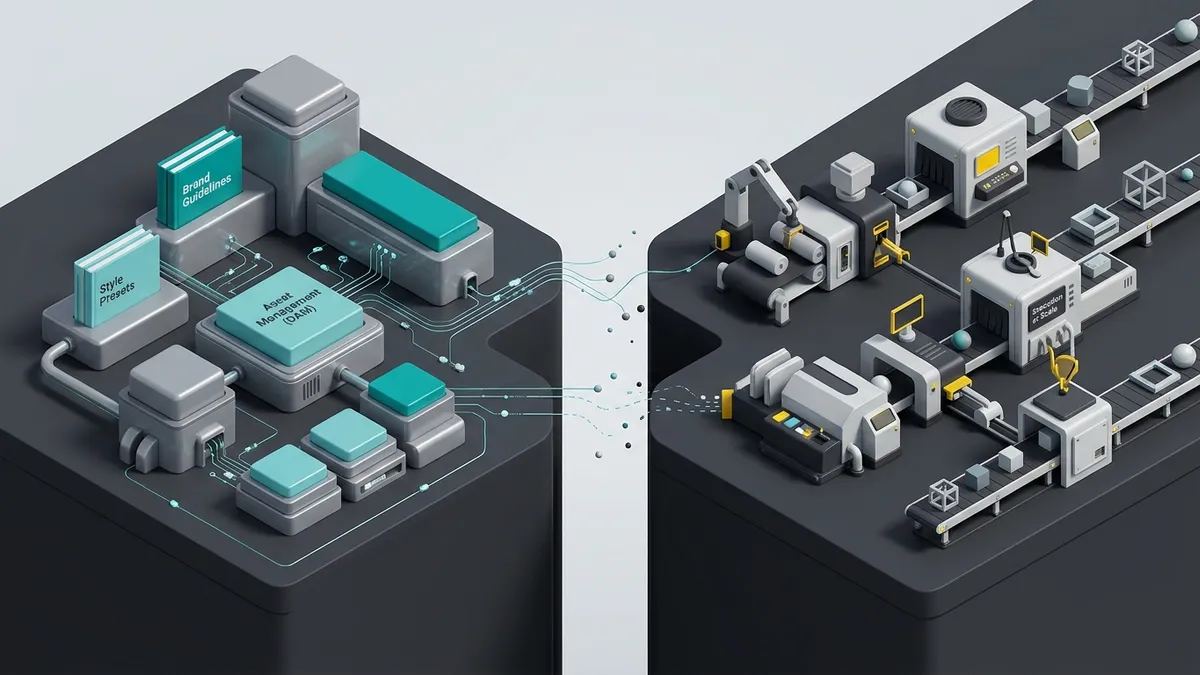
Traditional DAMs are often perceived as warehouses rather than factories. If you are asking is your content management solution a warehouse or a factory, you are likely feeling the limitations of manual creation. This conversation often leads to exploring headless content management, which helps by separating the storage and structure of information from its final visual output. Frontify handles the "what" and the "how," but it does not inherently perform the "do." Unlike an AI content creation platform, it isn't built to generate 10,000 localized banner variations from a single data feed automatically.
The Alternative: Executing Brand Strategy with Brandeploy
When comparing Frontify's features with an execution-focused engine like Brandeploy, a fundamental shift in philosophy emerges. Brandeploy integrates brand management directly into the heart of a content factory. Instead of the brand guide being a static document, the rules become active parameters that govern the automatic generation of content variations. This ensures that every piece of content created is "on-brand" by design, not by manual check.
For brands running heavy digital advertising, this distinction is critical. Using an automatic visual creation tool for Facebook ads allows teams to refresh creatives instantly, preventing ad fatigue without increasing the design team's workload. By bridging the gap between brand rules and asset production, companies can achieve a level of agility that a traditional brand portal cannot provide on its own.
The Brandeploy Advantage: Scaling Personalization and Impact
Brandeploy acts as an evolution of the brand portal concept by unifying the rule and the execution. While it offers the essential brand guidelines and asset management found in Frontify, its primary mission is action. It allows for accelerating campaign deployment by automating the repetitive parts of the design process. This is particularly valuable for B2B organizations looking for a B2B enterprise content automation solution that respects complex brand hierarchies.
To truly understand the impact of this approach, one must look at creative automation KPIs, which measure how much time and budget are saved when manual resizing and localization are removed from the equation. Optimizing marketing content production involves integrating these capabilities so your team can focus on strategy rather than production loops. For those currently using a DAM and creative platform integration, adding an automation layer is the final step to a fully optimized tech stack.
If Frontify is not the right fit, see our comparison of Frontify alternatives. Whether you are comparing Bannerbear alternatives or tools like CHILI publish, the goal remains the same: efficiency. By moving from a passive brand repository to an active creation engine, your marketing team can maintain total control while achieving unprecedented speed. This transition is the core of content automation and its benefits for the modern enterprise.
Brandeploy: The Creative Automation Engine for Brand Leaders
Brandeploy is a creative automation and brand management platform that helps enterprise teams scale content production, banner creation, localization, and campaign deployment across multiple markets. While Frontify serves as an excellent repository for rules, Brandeploy turns those rules into a high-speed production engine that generates thousands of on-brand assets in seconds. Our solution allows marketing teams to move from managing brand guidelines to deploying them at scale, ensuring every piece of content remains perfectly aligned with your visual identity. To see how you can transform your brand rules into an active content factory, book a demo.
FAQ
What is the main difference between Frontify and Brandeploy?
Frontify is primarily a Brand Management platform designed to centralize guidelines and assets. While it offers excellent DAM and brand portal capabilities, it serves as a repository. In contrast, Brandeploy is a creative automation platform that focuses on execution, allowing teams to generate thousands of content variations automatically using active brand rules.
When should a company choose Frontify for brand management?
Frontify is an ideal solution for large organizations needing to centralize brand guidelines, digital assets, and stakeholder collaboration. It ensures brand consistency across global teams by providing a 'single source of truth' for how a brand should look and feel, though it lacks high-volume automated production tools.
How does creative automation improve brand consistency?
Creative automation uses technology to scale content production while maintaining brand integrity. By integrating brand rules directly into a content factory, platforms like Brandeploy help marketing teams eliminate repetitive design tasks, reduce production costs, and accelerate the deployment of high-performing digital campaigns.
Can Frontify be used for high-volume content production?
A Digital Asset Management (DAM) system like Frontify acts as a warehouse for storing and organizing files. A Creative Automation platform acts as a factory, using those assets to build new content. For maximum efficiency, many enterprises choose a DAM and creative platform integration to bridge the gap between storage and production.
What are Frontify's core features?
Frontify's core strengths are brand portals, digital asset management (DAM) and interactive brand guidelines. Together they give internal employees and external agencies a single source of truth for the brand's visual and strategic identity, which helps prevent brand dilution. Frontify defines how the brand should be used, but it does not generate new assets automatically.

Written by
Jean-Baptiste Duquesne
SEO, GEO & content operations
Web pioneer since 1995, founder of the recipe site 750g.com (sold to Webedia), now industrialising SEO and GEO content production with AI.
Ready to scale your content production?
Book a demo