Creative automation examples: 8 real campaigns
Eight real, published creative automation examples from retail, beauty, media, restaurants, hospitality, FMCG and sport: what each brand automated and the results as reported by the source.

Jean-Baptiste DuquesneSEO, GEO & content operations · Published 25 October 2026 · Updated 13 November 2026
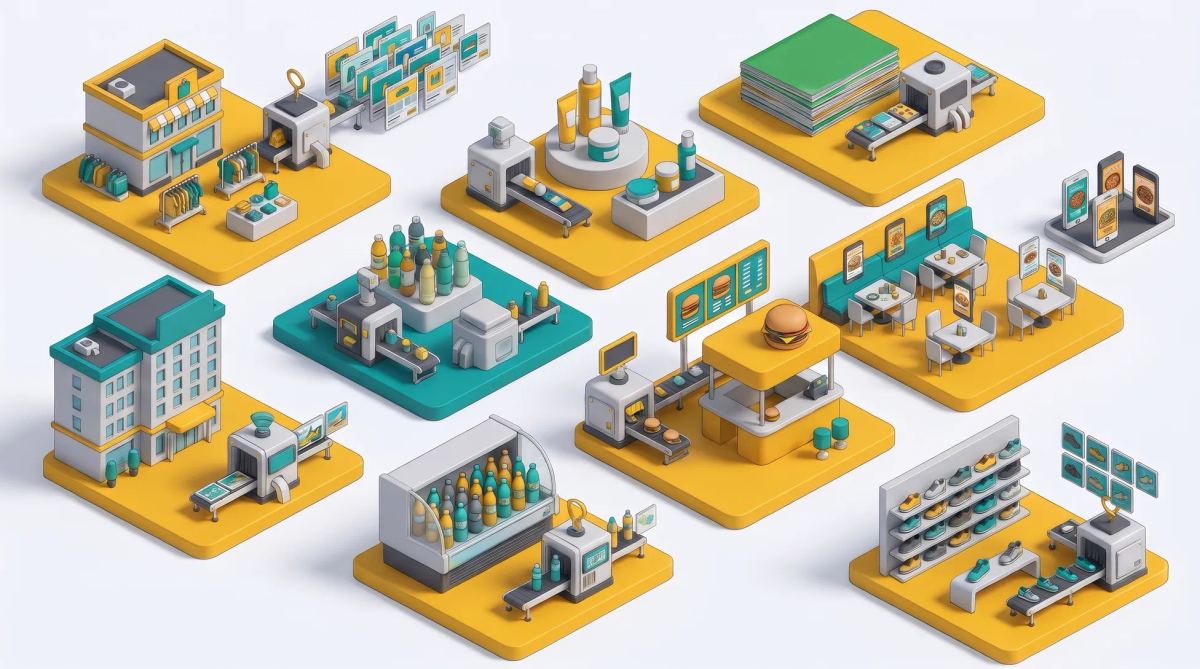
In short: here are eight real creative automation projects, from retail, beauty, media, restaurants, hospitality, beverages, quick service and sport. Each one follows the same pattern: master templates, data or local input, many variations, and approval built into the process. Every figure below comes from the case study published by the vendor concerned and is reported as such.
What counts as creative automation (in 60 seconds)
Creative automation means producing creative variations automatically from templates, rules and data: formats, languages, markets, products or audiences. To read the examples, look at four things: the format, the volume, the localization and the autonomy given to non-design teams. For a full definition, read creative automation: definition and marketing use cases.
| Brand | Industry | What was automated | Vendor | Published result |
|---|---|---|---|---|
| BHV Marais | Retail | Acquisition creatives from templates and Excel | Brandeploy | Up to 10x more creatives, CPMs halved |
| Nuxe | Beauty | Local adaptation of campaign toolkits | Brandeploy | 60 markets, €350K local savings |
| Bayard | Media | Monthly banner sets in every format | Brandeploy | 80% time saved, 75% cost reduction |
| Au Bureau | Restaurants | Local social posts by franchisees | Brandeploy | Social accounts doubled, 70% of restaurants active |
| Meliá Hotels International | Hospitality | Display production for 7 brands | Bannerflow | 50% less time to build display campaigns |
| Heineken | Beverages | Localized content from templates | Storyteq | 40% lower production costs, 40K localized assets |
| McDonald's Nordics | Quick service | Central production for 4 countries | Celtra | 12.8x production efficiency |
| Nike | Sport | Global Member Days toolkit localized by markets | Celtra | 19.5x production efficiency |
Retail: BHV Marais multiplies acquisition creatives (Brandeploy)
BHV Marais set up an in-house studio that designs campaigns as adaptable templates for all product ranges. Acquisition teams now produce on their own: visuals are generated from an Excel file or a product sheet, animated or static campaigns launch without the studio, and dozens of visuals come out of a single template. According to the BHV case study, the retailer produces up to 10 times more creatives tailored to more audiences and halved its CPMs. "We needed to produce more, faster, while maintaining quality," says Jérôme Schmitt, Image, Content & Media Manager. Read more on creative generation from Excel files.
Beauty: Nuxe localizes campaigns for 60 markets (Brandeploy)
Nuxe needed to adapt large toolkits of videos, banners and product ads for markets worldwide. Graphic designers now upload content to a central platform, and local teams translate, resize and personalize assets themselves, without design skills. Global teams monitor usage and brand consistency. According to the Nuxe case study, the brand works this way across 60 markets and reports €350K in local savings.
Media: Bayard automates its monthly banner batch (Brandeploy)
Adapting a single banner into dozens of formats used to take Bayard five days spread over two weeks, with freelancers. Its teams, without in-house designers, now use dynamic templates that adjust formats, messages and visuals automatically for CRM, display, social and the website. According to the Bayard case study, the group produces its batch of 55 banners a month with 80% time saved and a 75% cost reduction. Read more on multi-format banner creation.
Restaurants: Au Bureau franchisees post on-brand content (Brandeploy)
Au Bureau gives franchisees ready-to-use templates to create on-brand social posts, schedule them in a few clicks and sponsor them locally, from a mobile app. Each account is connected to Facebook and Instagram, and headquarters monitors publications, followers and reach. According to the Au Bureau case study, the network doubled its number of social accounts and reports 70% of restaurants active.
Hospitality: Meliá centralizes display production (Bannerflow)
Meliá Hotels International's in-house team produces display campaigns for seven brands and two loyalty programs, across 43 countries and nine languages, in one workflow. Bannerflow reports "a 50% reduction in the time it takes to build all their display campaigns" (Bannerflow case study).
Beverages: Heineken scales localized content (Storyteq)
Heineken's markets build content from pre-approved templates, with guidelines in a central portal. Storyteq reports a 40% reduction in content production costs, 40,000 localized assets generated from templates and 4,600 users across 80 countries (Storyteq case study).
Quick service and sport: McDonald's Nordics and Nike (Celtra)
McDonald's Nordics set up a central production system for four countries, covering kiosks, the app and paid media. Celtra reports a 12.8x increase in production efficiency, with an average of 36 seconds per creative (Celtra case study).
Nike, for its Member Days campaign, used a global toolkit of templates that markets localized, producing more than 17,000 creatives in one cycle. Celtra reports a 19.5x gain in production efficiency (Celtra case study).
What these examples have in common
- Locked templates: the brand is protected by design, not by manual checks.
- Data or local input: product sheets, spreadsheets or local offers feed the templates.
- Local autonomy: markets, stores or franchisees produce without the central studio.
- Integrated approval: validation happens in the same flow.
- Measurement: time, cost and volume are tracked before and after.
To measure your own project, read creative automation KPIs and our creative automation guide. To compare platforms, read our creative automation platforms comparison.
Brandeploy: the platform behind BHV, Nuxe, Bayard and Au Bureau
Brandeploy is a creative automation platform that produces visual and banner variations from brand-locked templates, translates and localizes creatives, routes them through approval workflows and stores final files in its DAM. Watch the use cases in video or book a demo.
FAQ
What is an example of creative automation?
BHV Marais generates acquisition visuals from an Excel file or a product sheet using adaptable templates, so its teams produce up to 10 times more creatives without involving the studio for each one.
Which industries use creative automation the most?
Retail, consumer goods, beauty, hospitality, quick service restaurants, media and franchise networks: any sector with many products, markets or local points of sale.
How do you measure the ROI of creative automation?
Compare production time, production cost and volume of creatives before and after, and track media results such as CPM or conversion when more targeted variations become possible.
Can local teams use creative automation without design skills?
Yes. In the Nuxe, Au Bureau and Heineken examples, local teams or franchisees adapt locked templates themselves, without design skills, while the brand stays protected.
What is the difference between creative automation and generative AI?
Generative AI creates new content from a prompt. Creative automation produces controlled variations from approved templates and data. Many platforms now combine both, using AI inside templates.

Written by
Jean-Baptiste Duquesne
SEO, GEO & content operations
Web pioneer since 1995, founder of the recipe site 750g.com (sold to Webedia), now industrialising SEO and GEO content production with AI.
Ready to scale your content production?
Book a demo