Baidu ERNIE 4.5: features and implications
The global AI landscape is being redrawn For the past several years, the narrative around cutting-edge artificial intelligence has been dominated by a handful of Western tech giants. However, the global balance of power is shifting, and…

Jean-Baptiste DuquesneSEO, GEO & content operations · Published 15 July 2025 · Updated 12 October 2026
The global AI landscape is being redrawn
For the past several years, the narrative around cutting-edge artificial intelligence has been dominated by a handful of Western tech giants. However, the global balance of power is shifting, and the release of Baidu's ERNIE (Enhanced Representation through kNowledge IntEgration) 4.5 is a testament to this new multipolar reality. More than just another large language model (LLM), ERNIE 4.5 represents a significant strategic move by the Chinese tech behemoth. By understanding the algorithms that power these systems, we see how Baidu is not only challenging the closed-off approach of competitors but also aiming to catalyze innovation on a global scale.
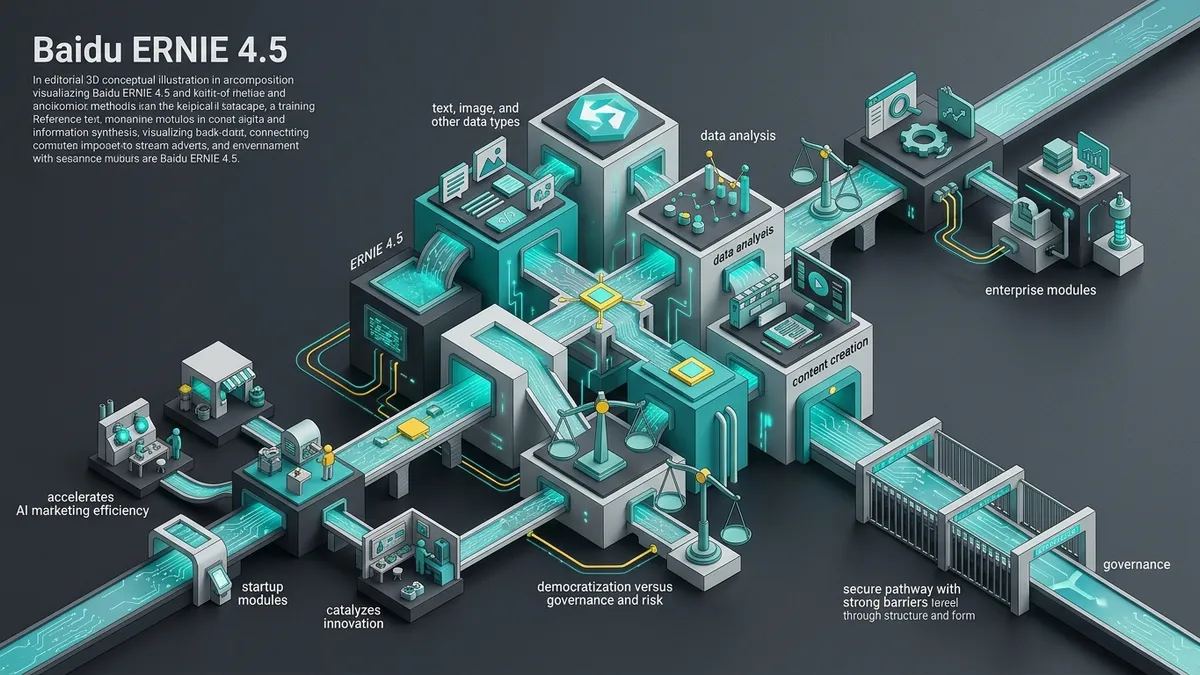
ERNIE 4.5 isn't just about text; its multimodality means it can understand and process a combination of text, images, and other data types. This makes it a versatile tool for a vast range of applications, from sophisticated AI content creation to complex data analysis. This release is a clear signal that the future of AI development will not be monolithic. It will be a diverse ecosystem of powerful models from different corners of the globe, each with unique architectures and capabilities, fundamentally changing the tools available to businesses and developers worldwide.
The implications of such a powerful open-source model are profound. It dramatically lowers the barrier to entry for companies looking to leverage state-of-the-art AI. This shift is part of a broader open source AI movement that is reshaping how technology is shared and developed, particularly in the field of generative AI and its ability to synthesize information. To refine these raw foundational capabilities for specific enterprise needs, developers often rely on Supervised Fine-Tuning to align model responses with desired outcomes. However, the accessibility that makes ERNIE 4.5 so exciting also amplifies the risks of Shadow AI, where employees integrate tools into their workflows without official oversight. This is why a solid deployment process is critical for enterprise security. The capabilities of models like ERNIE 4.5 are precisely what power disruptive technologies like Google's AI Overviews, which have led to a significant drop in media traffic for publishers globally.
Challenge 1: Democratization versus governance and risk
The double-edged sword of open source
The decision to open-source a model as capable as Baidu Ernie 4.5 is a classic double-edged sword. On one side, it's a massive boon for democratization. Startups that lack the billions of dollars required to train a foundation model from scratch can now build upon a state-of-the-art foundation. This improves efficiency by allowing smaller teams to do more with less. It fosters a collaborative environment where a global community can inspect code and identify flaws. However, open access means access for everyone, including malicious actors. This places an enormous burden on the community to establish norms for AI ethics to prevent the generation of disinformation or autonomous cyberweapons.
The explosion of Shadow AI
For corporations, the proliferation of powerful, free models like ERNIE 4.5 pours gasoline on the fire of Shadow AI. Employees, eager to boost their productivity, will inevitably turn to these tools. While the intent is positive, the risks are immense regarding data privacy. When an employee uploads a confidential document to an external interface, security is compromised. This is a primary organizational challenge that leadership must address immediately. It can also lead to an inconsistent brand voice, bypassing established quality controls. Furthermore, companies must worry about AI hallucinations that could damage brand credibility if content is generated and published without human-in-the-loop validation.
Challenge 2: Navigating the new global AI ecosystem
Adapting business strategy for multimodal AI
The multimodality of ERNIE 4.5 is a game-changer, and businesses must adapt their strategies to leverage it. A unimodal, text-only approach is no longer sufficient. Multimodal AI can understand the relationship between an image and its description, which is essential for modern marketing automation. For example, e-commerce companies can use it to create proactive chatbots that analyze user-uploaded photos to find products, confirming that ChatGPT and shopping are just the beginning of this retail revolution. This shift toward AI-augmented creativity allows human and machine to work together as a creative duo. To stay competitive, companies must rethink product design and marketing models to incorporate these new multidimensional data capabilities.
The strategic challenge to Western dominance
The rise of ERNIE 4.5 is a significant geopolitical event. It directly challenges the perceived dominance of US-based AI labs like OpenAI and Google. For international businesses, this provides alternatives and reduces reliance on a small number of providers. A company operating in Asia might find that a model developed by Baidu is better tuned to local languages. This also raises the challenge of keeping one brand voice in every market. Integrating these diverse systems requires a sophisticated marketing strategy. Furthermore, as industries shift, professionals must focus on future skills to manage this increasingly complex technology stack and remain relevant in an augmented future.
Brandeploy: ensuring control in a multimodal AI world
The emergence of incredibly powerful and accessible models like Baidu Ernie 4.5 presents a serious challenge for brand governance. When any employee can generate content with uncontrolled AI tools, brand integrity is at stake. Brandeploy solves this by providing a sanctioned, secure, and brand-centric ecosystem for creation. Our platform allows enterprise teams to scale content production while keeping every output 100% on-brand through intelligent templates and automated workflows. By centralizing assets and providing controlled AI integration, we eliminate the risks of brand dilution and data leaks. To see how you can maintain perfect consistency while leveraging the power of automation, book a demo of the Brandeploy platform today.
FAQ
What is Baidu Ernie 4.5 and how does it work?
Baidu Ernie 4.5 is a sophisticated multimodal large language model (LLM) developed by the Chinese tech leader Baidu. It is designed to understand and process various data formats, including text, images, and video, simultaneously. Unlike previous closed iterations, the 4.5 family emphasizes high performance across complex reasoning tasks and creative content generation within a global AI ecosystem.
What are the benefits of open-source multimodal AI for businesses?
The open-source nature of Ernie 4.5 provides small businesses and developers with free access to state-of-the-art AI infrastructure. This democratizes innovation, allowing companies to build specialized, localized applications without the massive R&D costs typically associated with training foundation models from scratch, effectively leveling the playing field with Western tech giants.
How does Ernie 4.5 contribute to the risk of Shadow AI?
Shadow AI refers to the unauthorized use of AI tools by employees within an organization. Powerful models like Ernie 4.5 increase this risk, as staff may upload sensitive data to external platforms for productivity. This creates significant security vulnerabilities, potential data breaches, and non-compliance with regulations like GDPR or CCPA if not managed correctly.
What are the industrial use cases for multimodal AI?
Multimodal AI models can interpret context across different media types. For instance, in e-commerce, it can analyze a customer's photo to recommend matching products. In manufacturing, it can process visual sensor data alongside technical manuals to perform real-time predictive maintenance and autonomous quality control, far exceeding the capabilities of text-only AI systems.
How can companies safely integrate global AI models into their workflow?
To mitigate risks, companies should implement a governance framework that provides sanctioned, secure AI tools. Using platforms that integrate AI within a brand-safe environment ensures that data remains protected while maintaining creative consistency. Training employees on responsible AI use and establishing clear data privacy protocols is also essential for long-term safety.

Written by
Jean-Baptiste Duquesne
SEO, GEO & content operations
Web pioneer since 1995, founder of the recipe site 750g.com (sold to Webedia), now industrialising SEO and GEO content production with AI.
Ready to scale your content production?
Book a demo