Distributed marketing platform: empowering local teams within brand rules
What a distributed marketing platform is, which features matter, how it differs from a DAM or a brand portal, and how to choose one so local teams can produce on-brand content.

Jean-Baptiste DuquesneSEO, GEO & content operations · Published 25 October 2026 · Updated 13 November 2026
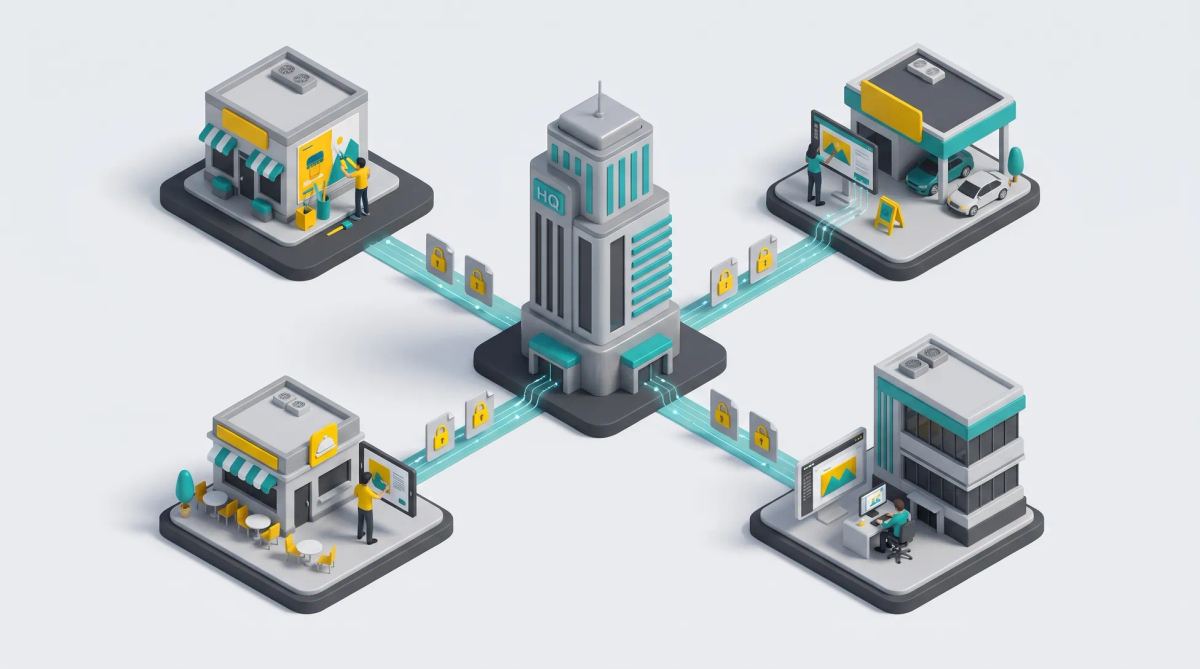
In short: a distributed marketing platform lets headquarters provide approved content and templates, and lets local teams, franchisees, distributors and partners adapt, produce and publish them without breaking the brand guidelines. It is neither a simple DAM, which stores finished files, nor a simple brand portal, which publishes rules: its job is to let the network produce compliant local content on its own.
What is a distributed marketing platform?
A distributed marketing platform is software that connects a central brand team with the people who market the brand locally. Headquarters supplies approved assets and locked templates; local teams and partners adapt them to their market, store or audience, then download or publish them, sometimes after approval.
The term is used in two ways. In the sales enablement sense, popularized by CRM vendors, it means pre-approved emails and content that sales reps or agents personalize for their contacts. In the brand and local marketing sense, it means visual templates for points of sale, franchisees, subsidiaries and partners. This article focuses on the second sense. Learn more about brand management in Brandeploy.
Who needs one: typical distributed organizations
Any brand whose content is produced or published by people outside the central team:
- Franchise networks: local promotions, store events, local social accounts.
- Multi-store retail: posters, price changes, opening hours.
- Country subsidiaries: translation and adaptation of global campaigns.
- Distributors and resellers: product visuals and co-branded materials.
- Agent networks in insurance or real estate: local ads and listings.
- Car dealerships: local offers on national models.
A real example: Au Bureau, a French restaurant franchise, gives its franchisees ready-to-use templates to create on-brand posts, schedule them in a few clicks and sponsor them locally from a mobile app. According to the Au Bureau case study, the network doubled its number of social accounts and reports 70% of restaurants active. See also local market autonomy: relevance vs brand consistency.
Core features to expect
| Feature | What it solves for local teams | Question to ask vendors |
|---|---|---|
| Locked templates with editable zones | Produce without design skills and without breaking the brand | Can we choose exactly which fields each role can edit? |
| Approved asset library | Always use the latest logo and visuals | How are outdated assets withdrawn everywhere? |
| Roles by region, brand or point of sale | Each user sees only what concerns them | Can permissions follow our organization chart? |
| Localization and translation | Adapt global campaigns to each language | Is translation applied inside the template? |
| Approval before distribution | Legal and brand checks without email chains | Can approval be required for some templates only? |
| Distribution and usage tracking | Download, publish to social, print | Can headquarters see which templates are used, where? |
For template governance, read template management system and brand governance platform.
Distributed marketing platform vs DAM vs brand portal
| Tool | Main job | Who uses it locally | Can local teams create new content? |
|---|---|---|---|
| DAM | Store and distribute finished files | Download only | No |
| Brand portal | Publish rules and approved assets | Consult and download | Rarely, or within limits |
| Distributed marketing platform | Let the network produce compliant local content | Adapt, produce, publish | Yes, within locked templates |
Read more in brand portal: what it is and how it differs from a DAM and our DAM guide.
Benefits and risks: autonomy vs control
The benefit is local speed without multiplying agencies: the network produces what it needs when it needs it. The risk is brand drift if templates are too open, or abandonment if they are too locked and local teams go back to their own tools.
Nuxe illustrates the balance: graphic designers upload content to the platform, and local teams in 60 markets translate, resize and personalize assets themselves, without design skills. Brandeploy's Nuxe case study reports €350K in local savings. Good practices: define two or three locking levels, train local champions, review template usage every quarter. See multi-market brand deployment.
How to choose a distributed marketing platform: checklist
- Ease of use for a non-designer on a first try.
- Locking granularity: field by field, not all or nothing.
- Geographic roles and multi-brand management.
- Formats covered: social, display, print, video.
- Built-in translation that keeps the layout.
- Approval workflow configurable by template or market.
- Integrations with your DAM, social networks and PIM.
- Usage tracking to see adoption by entity.
Market players include marketing suites with a distributed module, local marketing tools focused on franchises, and creative automation platforms. Compare several on a real local campaign.
Rolling it out: a 5-step plan
- Inventory local needs: what do local teams produce today, and with which tools?
- Prioritize 5 to 10 templates that cover most requests.
- Set locking rules for each template.
- Pilot with 2 or 3 markets and adjust.
- Roll out and measure: template usage by entity, production time, volume of local content.
Brandeploy for distributed marketing
Brandeploy is a creative automation platform where headquarters builds templates locked to the brand guidelines and manages roles and permissions by region, brand or project. Local teams and partners adapt, translate and get their creatives approved without source files. To see it on one of your local campaigns, book a demo.
FAQ
What is distributed marketing?
Distributed marketing is the organization of marketing across a network of local entities, such as franchisees, stores, subsidiaries, distributors or agents, which adapt and publish content provided by a central brand team.
What is the difference between distributed marketing and local marketing?
Local marketing is what each entity does for its own area. Distributed marketing is how headquarters equips and governs that local marketing across the whole network, with shared templates, rules and approvals.
Is a distributed marketing platform the same as a DAM?
No. A DAM stores and distributes finished files. A distributed marketing platform lets local teams create new compliant content from locked templates, and often includes or connects to a DAM.
How do you keep brand consistency across franchisees and partners?
Give them locked templates where only some fields are editable, keep a single library of approved assets, set permissions by role and region, and require approval for sensitive materials.
Which teams use a distributed marketing platform day to day?
Central brand and marketing teams build templates and rules; local marketers, store managers, franchisees, distributors and partners use them to produce their own materials.

Written by
Jean-Baptiste Duquesne
SEO, GEO & content operations
Web pioneer since 1995, founder of the recipe site 750g.com (sold to Webedia), now industrialising SEO and GEO content production with AI.
Ready to scale your content production?
Book a demo