Content operations (ContentOps) platform: what it is and how to choose one
What a content operations (ContentOps) platform is, which capabilities matter, all-in-one suite or connected stack, and how to choose one for marketing content production.

Jean-Baptiste DuquesneSEO, GEO & content operations · Published 25 October 2026 · Updated 13 November 2026
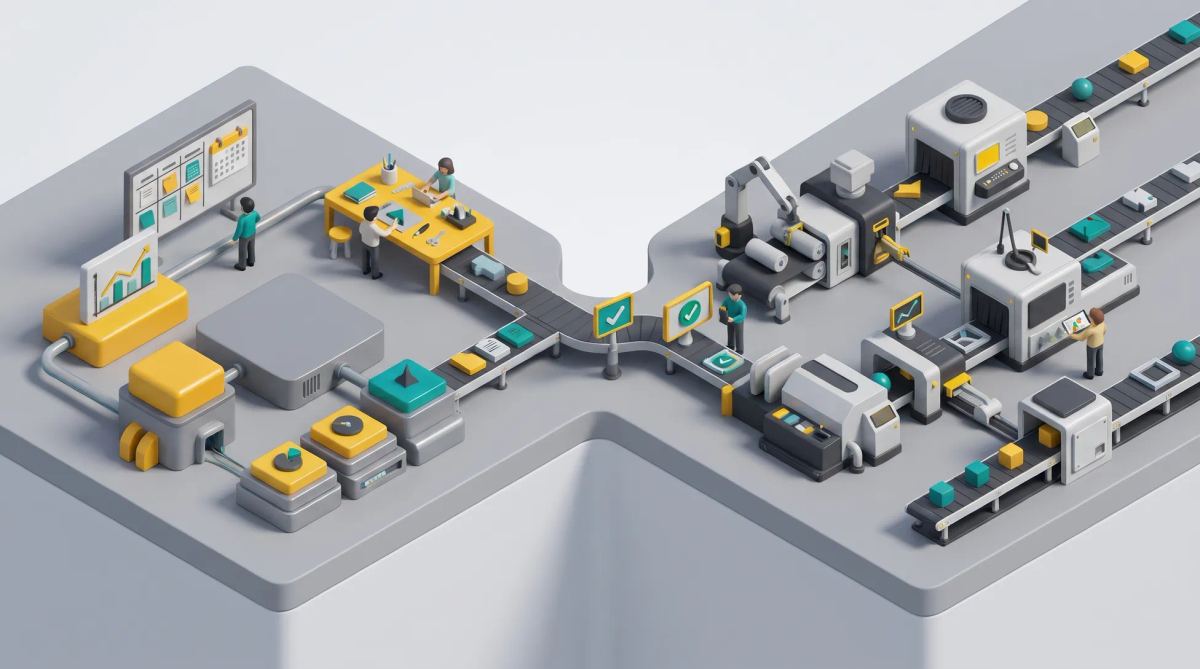
In short: content operations (ContentOps) is the organization of people, processes and technology that lets a team plan, produce, approve, distribute and measure content efficiently and repeatably. A ContentOps platform is rarely a single tool: it is a layer that connects planning, production, adaptation, approval, storage and distribution. To choose one, map your current flow, find the bottlenecks and decide between an all-in-one suite and a connected stack.
What is content operations (ContentOps)?
Content operations covers how content gets made, not what it says. Content strategy decides what to publish and why; content operations decides how: who does what, in which order, with which tools, under which rules. Most definitions in the market, from headless CMS vendors to DAM vendors, converge on the same three components: people, processes and technology.
What a content operations platform actually does
A ContentOps platform supports the content lifecycle from start to finish:
- Plan: calendar, briefs, priorities.
- Create: editor and templates.
- Adapt: formats, languages, markets.
- Approve: review and approval workflows.
- Store: DAM and version history.
- Distribute: connectors to CMS, social networks and ad platforms.
- Measure: reporting on production and performance.
Read more in streamlining the marketing content supply chain.
Signs you need a ContentOps platform
- Approvals happen by email, and nobody knows which version is final.
- Several versions of the same file circulate at once.
- Teams cannot find approved assets and recreate them.
- Variations are rebuilt by hand for every format and language.
- Local teams drift from the brand guidelines.
- Time to market keeps slipping.
See marketing content approval workflow and our DAM guide.
Key capabilities to look for
| Capability | What it solves | Question to ask the vendor |
|---|---|---|
| Workflow and approval | Email chains and lost versions | Can workflows differ by content type and market? |
| DAM | Assets that cannot be found | Is the DAM built in or connected to ours? |
| Locked templates and variations | Manual rebuilding of every format | Which formats can one template produce? |
| Localization | Slow, error-prone translation | Is translation applied inside the template? |
| Roles and permissions | Off-brand local content | Can permissions follow brands, markets and projects? |
| Integrations | Copy-paste between tools | Which PIM, CMS and DAM connectors exist? |
| AI | Slow first drafts and adaptations | Which AI models are used, and under which rules? |
| Reporting | No visibility on throughput | Can we measure production time and reuse? |
See also creative workflow automation.
All-in-one platform or connected stack?
| Criterion | All-in-one suite | Connected stack |
|---|---|---|
| Breaks in the flow | Few | More, unless integrations are solid |
| Flexibility | Limited to the suite | Best tool for each step |
| Integration effort | Low | Higher |
| Vendor dependency | High | Spread |
| Typical buyer | Large organization standardizing | Team with an existing DAM, CMS or PIM |
A connected stack usually combines project management, a DAM, a headless CMS and a creative automation platform. Read about headless content management.
How to choose: a 6-step evaluation
- Map your current flow, from brief to publication.
- Identify the bottlenecks: approvals, adaptation, search.
- Prioritize capabilities that remove those bottlenecks first.
- Test on a real case, such as a multi-market campaign.
- Involve local teams, who will use the tool daily.
- Define indicators: production time, number of review rounds, asset reuse.
Where AI fits in content operations
AI speeds up production and adaptation: first drafts, translations, visual variations, metadata. It does not replace governance or approval. A content factory needs templates, rules, workflows and people accountable for what goes out. Read AI content factory: why AI alone won't industrialize your content and content factory use cases.
Brandeploy in your content operations
Brandeploy covers the production and adaptation part of the ContentOps chain: creative automation with brand-locked templates, visual, banner and video variations, translation and localization of creatives, approval workflows and a DAM. It also generates product pages and SEO/GEO articles, and connects to other building blocks such as a third-party DAM or a PIM. Learn more about the Brandeploy platform or book a demo.
FAQ
What is the difference between content strategy and content operations?
Content strategy decides what to publish and why. Content operations decides how it gets produced: people, processes, tools and rules from planning to measurement.
What tools make up a content operations stack?
Typically a planning or project management tool, a DAM, a CMS, a creative automation platform for templates and variations, approval workflows, connectors to distribution channels and reporting.
Is a DAM a content operations platform?
A DAM is one building block of content operations: it stores and organizes assets. A ContentOps setup also needs planning, production, adaptation, approval and distribution.
Who owns content operations in a marketing team?
Usually marketing operations, sometimes a dedicated content operations lead, working with brand, studio, local teams and IT.
How do you measure content operations performance?
Track production time from brief to publication, number of review rounds, volume produced, asset reuse rate and time spent searching for assets.

Written by
Jean-Baptiste Duquesne
SEO, GEO & content operations
Web pioneer since 1995, founder of the recipe site 750g.com (sold to Webedia), now industrialising SEO and GEO content production with AI.
Ready to scale your content production?
Book a demo