The Future of Agencies in the Age of AI and Automation
AI and automation are reshaping the agency model: billing, production, approval. How agencies can become augmented strategic partners.

Jean-Baptiste DuquesneSEO, GEO & content operations · Published 22 October 2026
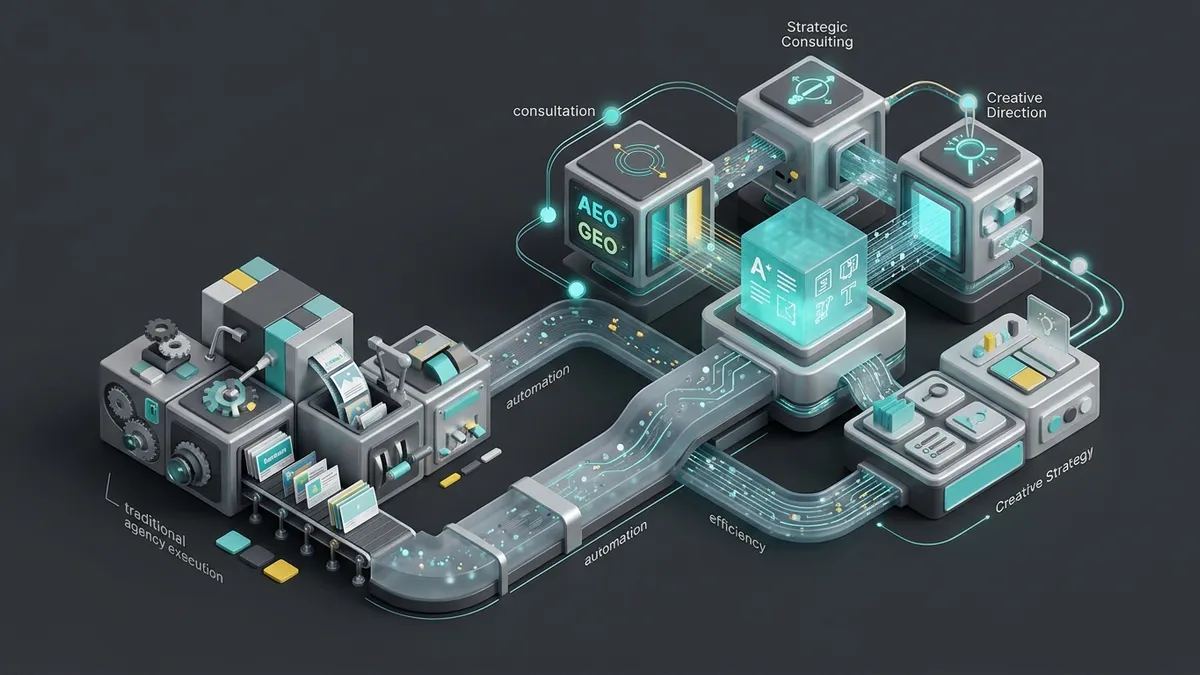
Marketing and communication agencies have reached a turning point. Brands expect more content, on more channels, with budgets under pressure. Artificial intelligence and automation are not making the agency business disappear: they are shifting its value from execution to strategy, consulting and creativity.
Do agencies still have a future?
The question comes up regularly: are agencies, in their traditional form, bound to disappear? The pressure on marketing budgets is real, while the need for quality content keeps growing. Brands still need to capture attention on Google through SEO (Search Engine Optimization, optimizing for traditional search engines). They also need to show up in the answers produced by artificial intelligence.
Two disciplines now complement SEO. AEO (Answer Engine Optimization) aims to get answer engines to use your content as a direct answer. GEO (Generative Engine Optimization) aims to get your content cited by generative AI such as ChatGPT, Perplexity or Google's AI Overviews. Staying effective in this new environment requires fast, structural change.
Today's challenges: volume, quality and tight budgets
Agencies and brands face very concrete problems. Marketing teams often find content production too slow. That slowness drives up costs and makes brand consistency harder across many channels: social media, display, email, points of sale and international markets.
Brand expectations are changing too. Brands want multichannel visibility, in SEO as well as in AI answers, and production that can keep up with trends and algorithm changes. They expect their agencies to be responsive without sacrificing quality.
What AI changes in the agency model
AI does not only change the speed of production. It challenges several fundamentals of the business.
- Time-based billing: when adapting a design into new formats takes minutes instead of hours, hourly billing becomes hard to defend. Many agencies are looking at fixed fees, subscriptions or performance-based pricing.
- Production roles: artwork production and format adaptation are the first tasks to be automated. The people doing them are moving toward template design, brand compliance and production management.
- The relationship with the brand: email threads are giving way to shared workspaces where the agency and the client produce and approve together. We cover these practices in our article on collaboration between agencies and brands.
AI: a tool for efficiency, not a threat to creativity
AI is not here to replace people but to assist them. Its role is to handle repetitive, time-consuming tasks: first drafts, format adaptations, visual variants for advertising. Creative workflow automation frees up valuable time for teams.
That time lets professionals focus on strategy, creativity, innovation and performance analysis. AI does not replace the expert, it equips them. For example, in a few seconds an AI can suggest dozens of headline ideas that the team then sorts and refines. People stay in control: they choose and approve.
Scaling visual production with Brandeploy
Brandeploy is a creative automation platform. It helps agencies and brands scale the creation and adaptation of their visuals, using approved templates that follow the brand guidelines.
In practice, the platform lets you:
- Produce dozens of variations of a display ad banner in minutes, where manual adaptation used to take hours.
- Automatically adapt your product visuals and banners for every format, market and language with creative translation and localization.
- Lock brand elements (logos, fonts, colors) so that every variation stays compliant.
The benefit shows in time and cost: fewer hours spent on manual adaptation, and more output without hiring at the same pace. To learn more about the features that matter to agencies, read our article on the ad creation tool for agencies.
Keeping control of the brand: the human role
Questions about quality and brand consistency are legitimate when using AI. AI is a powerful assistant, but people make the final decision. Your teams, on the brand side and on the agency side, review and adjust: the platform's approval workflows ensure that visual and editorial guidelines are respected.
AI-generated content should always be reviewed and approved to ensure it fits the brand and the strategy. People remain the guardians of the brand's identity and message.
Agencies: becoming augmented strategic partners
For agencies, automation is an opportunity to reinvent themselves. By handing time-consuming tasks to technology, teams can focus on what creates the most value: client strategy, consulting, innovation and new services.
The agency does not lose its role, it broadens it. It becomes a strategic partner with greater production capacity. It can take on more projects without growing headcount at the same pace, serve more clients and spend more time on creative work.
The future belongs to well-managed automation
Automation and AI do not threaten the future of agencies. They help agencies become more efficient and strengthen their role as essential partners for brands. Agencies that adopt these tools today, with clear approval rules, give themselves the means to stay competitive.
With our creative AI automation platform, agencies roll out their clients' campaigns at scale without leaving the brand guidelines. To see it with your own content, book a demo.
Sources:
- GEO: Generative Engine Optimization (P. Aggarwal et al., Princeton University, arXiv), definition of GEO, accessed October 22, 2026
FAQ
Do communication agencies still have a future in the age of AI?
Yes. AI and automation are not making the agency business disappear, they are shifting its value. Repetitive production tasks are increasingly automated, while strategy, consulting and creative work take on a bigger role. Agencies that adopt these tools with clear approval rules stay competitive.
What is the difference between AEO and GEO?
AEO (Answer Engine Optimization) means optimizing your content so that answer engines use it as a direct answer. GEO (Generative Engine Optimization) means optimizing it so that it is cited in answers from generative AI such as ChatGPT, Perplexity or Google's AI Overviews. Both complement traditional SEO.
Is AI a threat to creativity in agencies?
No. AI handles repetitive, time-consuming tasks such as first drafts or format adaptation. It frees up time for strategy, creativity and performance analysis. The expert stays in control: they choose, refine and approve.
How does Brandeploy help agencies scale their production?
Brandeploy is a creative automation platform. Using approved templates, it lets you adapt display banners and product visuals to every format, market and language while locking brand elements. The agency keeps control of strategy and creative work.
Who ensures quality and brand consistency when AI is used?
People make the final decision. Brand or agency teams review, adjust and approve each piece of content, and the platform's approval workflows ensure visual and editorial guidelines are respected. AI-generated content should always be reviewed before it is published.

Written by
Jean-Baptiste Duquesne
SEO, GEO & content operations
Web pioneer since 1995, founder of the recipe site 750g.com (sold to Webedia), now industrialising SEO and GEO content production with AI.
Ready to scale your content production?
Book a demo