From Freepik AI to ChatGPT Moodboard: How AI Tools Simplify Visual Creation Flows?
Creating high-quality visual content has traditionally been a resource-heavy process. However, the intersection of AI and content creation is fundamentally shifting how marketing teams approach the creative funnel. By leveraging tools like…
Rédaction BrandeployPublished 16 May 2025 · Updated 11 October 2026
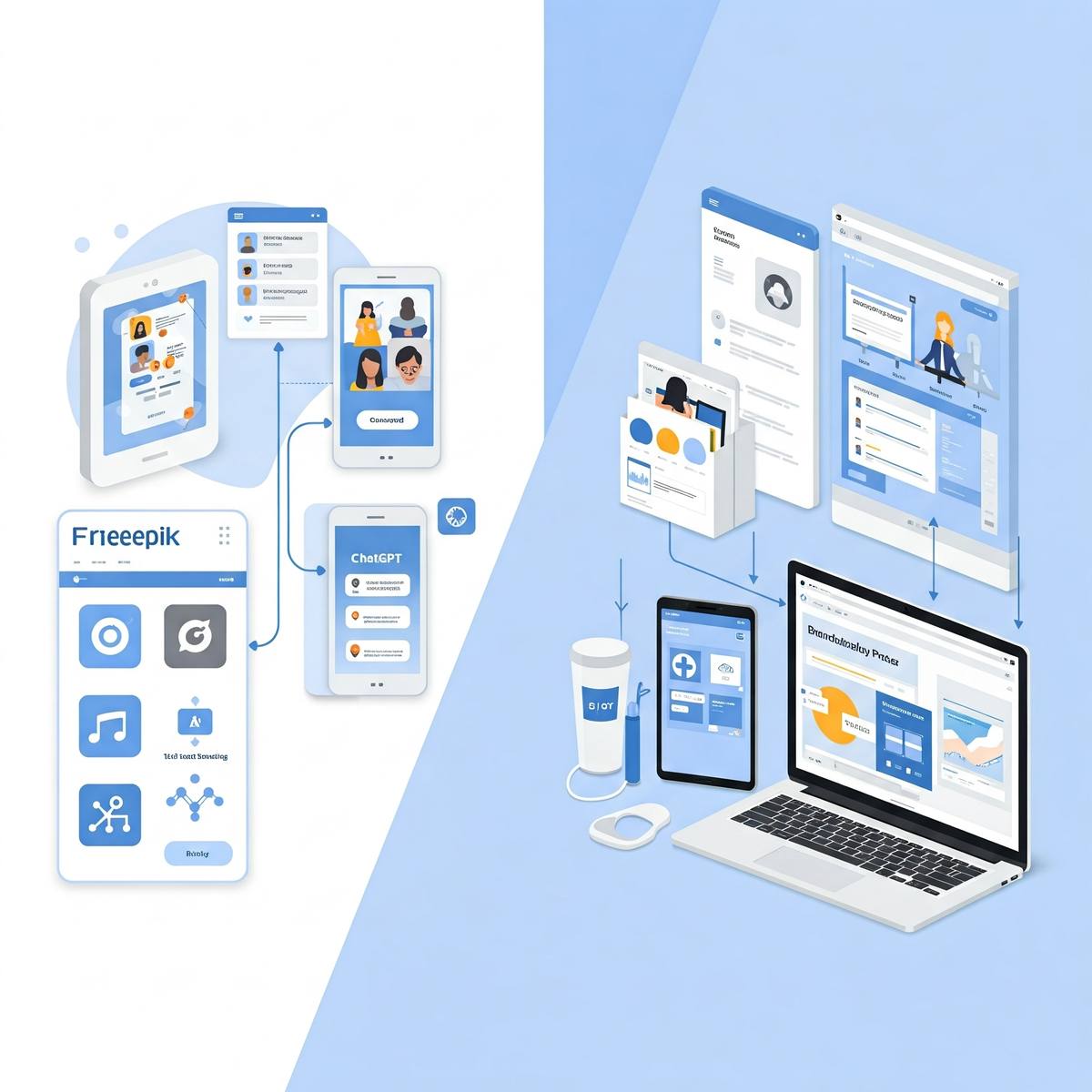
Creating high-quality visual content has traditionally been a resource-heavy process. However, the intersection of AI and content creation is fundamentally shifting how marketing teams approach the creative funnel. By leveraging tools like Freepik AI and ChatGPT, professionals can now bypass tedious manual sourcing and move straight into rapid prototyping and ideation and visualization.
The Rise of Guided Creative Workflows
One of the most significant shifts is the move from "blank canvas" tools to guided workflows. This transition is a key part of the modern AI deployment process, where the goal is to reduce friction between a creative brief and the first draft. Tools are becoming less about isolated pixel editing and more about high-level creative orchestration. However, as these systems generate more content, it is crucial to understand bias in AI to ensure the resulting visuals remain representative and inclusive.
Freepik AI: Guided Workflows for Seamless Visual Creation
Freepik, long known as a repository for graphic assets, has evolved with its AI Assistant. This tool offers guided workflows that leverage GPT-4o to act as a creative partner. Instead of just searching for keywords, users interact with the assistant to define the project scope—be it merchandising, interior decor, or specialized product photography.
This system integrates AI algorithms to suggest specific layouts, generate text, and propose image variations that fit a specific aesthetic. It excels at simplifying consistent visual content creation, allowing teams to maintain a high standard of quality without necessarily mastering complex design suites. For businesses, this serves as a practical bridge between big data and AI assets and finalized marketing materials. This trend toward expansive creative assistants is global, as seen with Kimi by Moonshot AI, which is currently shaking up the competitive landscape of high-context chatbots in international markets.
ChatGPT for Rapid Moodboard Creation and Ideation
At the start of any creative project, a moodboard is essential to align stakeholders. ChatGPT has transformed this phase from hours of searching Pinterest into minutes of prompt-based generation. Using multimodal capabilities, designers can upload a single reference image and ask the AI to build a visual grid based on specific AI clustering techniques, grouping similar moods, colors, and textures. High-speed visual planning is especially useful when you need to manage multiple instagram accounts easily while maintaining a distinct look for each profile.
This rapid AI deep research into styles allows for instant visualization before moving into AI production process stages. Whether you are using Midjourney or DALL-E 3, starting with writing prompts for ChatGPT to generate a moodboard ensures the creative direction is solid and communicable. This synergy between different tools is a cornerstone of AI augmented creativity, where the machine handles the breadth of options while the human focus remains on curation.
Limitations for Enterprise Scale and Brand Integrity
While these tools are revolutionary for inspiration, they often encounter hurdles in a corporate environment. AI hallucinations can lead to off-brand colors or inconsistent logos, which pose a risk to brand equity. Furthermore, maintaining AI global brand consistency across thousands of assets is difficult when using tools designed for one-off generations, especially in a world where sovereign AI concerns are rising.
Individual tools also struggle with the AI as an organizational challenge: they don't naturally integrate into validation workflows or existing DAM (Digital Asset Management) systems. To move from tactical experimentation to a truly integrated AI marketing model, enterprises need a way to industrialize these creative sparks, perhaps by using an AI API to connect different systems. This level of integration is increasingly seen in advanced ecosystems like Adroll: driving growth strategies for organizations that prioritize cross-channel consistency and data-driven performance.
Brandeploy: Scaling Production While Ensuring Brand Consistency
Brandeploy bridges the gap between the initial inspiration found in Freepik or ChatGPT and the rigorous demands of large-scale marketing. As a specialized creative automation and brand management platform, Brandeploy takes visual directions and translates them into smart, locked-down templates that guarantee total brand compliance. This is essential for achieving true AI marketing efficiency, allowing teams to produce hundreds of localized assets in minutes rather than days.
The platform ensures that every output is "on-brand" by connecting directly to your brand guidelines and asset libraries. Brandeploy humanizes these automated processes by giving teams control over the final output, effectively acting as a universal software teammate for creative departments. If you are looking to transform your creative ideation into a high-speed production engine, you should book a demo of the Brandeploy platform today.
FAQ
What is an AI moodboard?
An AI moodboard is a visual collage generated using artificial intelligence tools to define a project's creative direction. By using text prompts or reference images, AI can instantly suggest color palettes, textures, and styles, significantly accelerating the initial ideation and visualization phase for designers and marketing teams.
How does Freepik AI simplify graphic design?
Freepik AI simplifies workflows by providing guided templates for specific projects like product photography or merchandising. By combining GPT-4o with Freepik's asset library, it helps users generate consistent visual content creation without needing advanced graphic design skills or mastering multiple complex software tools.
What is the difference between AI ideation and creative automation?
Creative automation refers to the use of technology to automate the scaling, adaptation, and distribution of visual content. While tools like ChatGPT help with ideas, creative automation platforms like Brandeploy take over to industrialize the production of hundreds of brand-compliant assets across various formats and languages.
How can I scale my brand's visual production using AI?
Scaling visual production requires moving beyond manual design. By using an integrated AI marketing model and automated templates, brands can generate thousands of variations for social media, display ads, and email campaigns while ensuring 100% brand consistency and centralizing assets in a DAM system.
Written by
Rédaction Brandeploy
Ready to scale your content production?
Book a demo